


I’m as short attention spanned as the next person these days. It feels like I’m constantly writing down my “to do” list everywhere (on scraps of paper, my iPhone notes app, the back of my hand) to keep moving forward productively.
And while I’m getting better at scanning things that hit my inbox and moving on, I just can’t resist big graphics with compelling visuals:
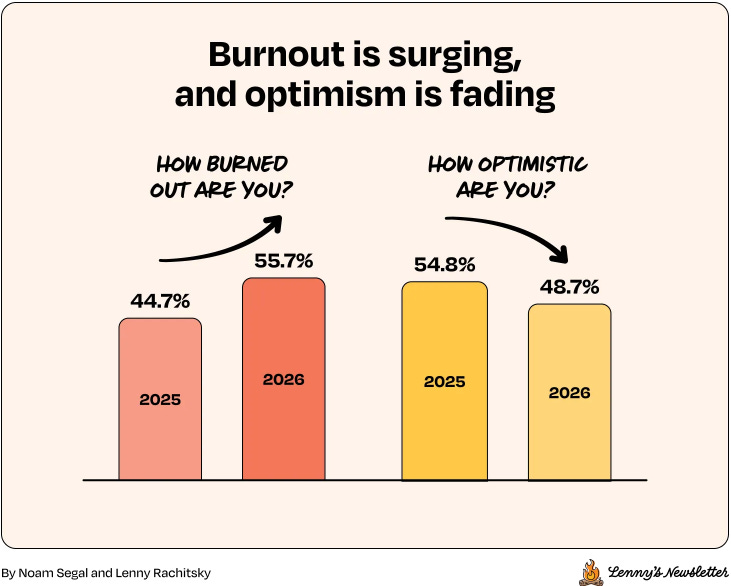
This is one of several cool-looking graphics in a substack called Lenny’s Newsletter. I don’t know Lenny, but it looks like he and the guest author of this post (Noam) have been doing a lot of surveying to get a read on how tech workers are feeling in 2026. The image above is from this post, and the article by Johannes Sundlo covers a lot of results from their user surveys. (Note: I didn’t read the post, just scanned the graphics.)
I did read a shorter post (on a different site, not Lenny’s) that used the same graphic, this one with a title screaming: “HR is asleep and people are burning”.
Geeze, I really hope the HR department isn’t literally letting people burn?
Let’s spend a minute on human resources (HR) or people operations (PO) as the newer department name goes. Despite the popular tech narrative that it’s an unnecessary function, people operations can absolutely be a force multiplier for an organization, when done right. So, simply put, what does “done right” look like?
PO contributes in three important areas, specifically establishing and managing the:
Systems that support people and the company. This can include choosing and managing the platform that ensures benefits (e.g. healthcare) are easy to manage at the employee level, and it can also include managing the compliance complexities that any organization needs to comply with at the state and federal level (e.g. parental leave).
Process through which the organization recruits, hires, and onboards new team members. There’s no silver bullet for how this is done, and the best PO teams work closely with every other functional group to understand how to best source candidates and efficiently architect the interviewing and hiring flow. Think about it. What works within the engineering department is likely to be fairly different than in the sales team. And crucially, great PO teams really focus on how to onboard new team members so these folks are able to productively contribute as close to day one as possible.
Effort to develop talent by investing in manager development. We all know the data: an employee’s relationship with their manager becomes the single most important factor that drives employee engagement and retention, or conversely, that causes team members to disengage and look for a new job.
But wait, what the post above implies is that it’s HR’s or the PO department’s job to get all this right, otherwise, people will be burning. Let’s be clear. The PO department isn’t solely responsible for ensuring every team member’s personal happiness and engagement. Yes, they are accountable for doing the best job they can in the three areas above, but ultimately the key is how YOU as a team member take control of your experience in the workplace.
Whether you’re at a five-person startup or a 50,000-employee multinational corporation, there are a few clear things YOU need to prioritize and be responsible for when it comes to being happy and engaged in your work:
Communicate and engage consistently with your manager so you two are aligned on what the organization’s strategic priorities are and how your work connects directly to those priorities. If you work in a privately held company or a nonprofit, know your organization’s financials, operating model, and path to profitability. Pro tip: don’t skip your weekly or bi-weekly 1-1s with your manager, and if they have to cancel your 1-1, insist on rescheduling so communication gaps don’t emerge.
Know your responsibilities and what you’re accountable for each quarter, then translate that into how you focus your effort each month and week. For individual contributors (IC), give thought to if you want to be a people manager and what that path looks like. For managers, you have the challenge of ensuring you know your own responsibilities via conversations with your manager, while also being adept at translating to your direct reports what their responsibilities look like. Pro tip: don’t assume AI is going to replace managers, act like no role will be more critical than a manager.
Commit to work hard and deliver high-quality work output, depending on what this looks like for your functional area. For example, what do the best engineers in your organization do and how do you describe their work ethic? Likewise, what does this look like for the top people in marketing, finance, revenue operations, and every other role across your organization? Pro tip: don’t be outworked, and if this feels hard for you to achieve, then maybe you need to find a new organizational mission.
Lift others up and be seen as the ultimate “team first” employee. Feelings of connectedness, engagement, happiness, and regeneration all flow from being in service of others. In today’s world where it might appear that it’s “me first” and about “building my personal brand”, the reality is what really matters is how the organization and team you’re a part of does. That’s what energizes you in the moment and what you recall and remember long after you’ve moved on.
I do appreciate the sentiment shared in Sundlo’s post. It’s admirable when any function raises their hand and says “we need to do better”, but in this case I’d suggest that the “we” starts with each team member ticking through the themes above. If you aren’t bought in on those and living them, not even the greatest PO department that’s providing the greatest set of HR systems, platforms, and tools will be able to make you happy and engaged. That’s on you.
NextPlay>Forward AI Disclaimer: I very actively use artificial intelligence and large language models to generate the content you read here, but I do review it and edit it to make sure it can be generally useful to people who read it. Keep in mind that AI can make mistakes - check important information. Let me know if I make any errors and I will correct them.