


As a startup CEO, a major part of my role revolves around the different ways I share with our team members at Remind how we might imagine what we are building together. Much of this effort points back to defining and continuously revisiting our mission, vision, and values. Other important themes flow in as well, oftentimes centered on important cultural elements like responsibility, accountability, collaboration, passion, and commitment, to name just a few.
Over the last few weeks as we have continued to broaden the lens through which we imagine Remind’s future, I’ve thought a lot about how to tie everything together in a way simple way. Specifically, I’ve been looking for a construct that provides a succinct construct that enables all of us at Remind to think about our personal roles, our mutual connection to our users and customers, and our efforts to collaborate in a way that puts “we” ahead of “me” when it matters most. So, as I’m apt to do, I sketched in my notebook to craft a visual representation of what this looks like in three core elements: Impact, Sustainability, and Trust.
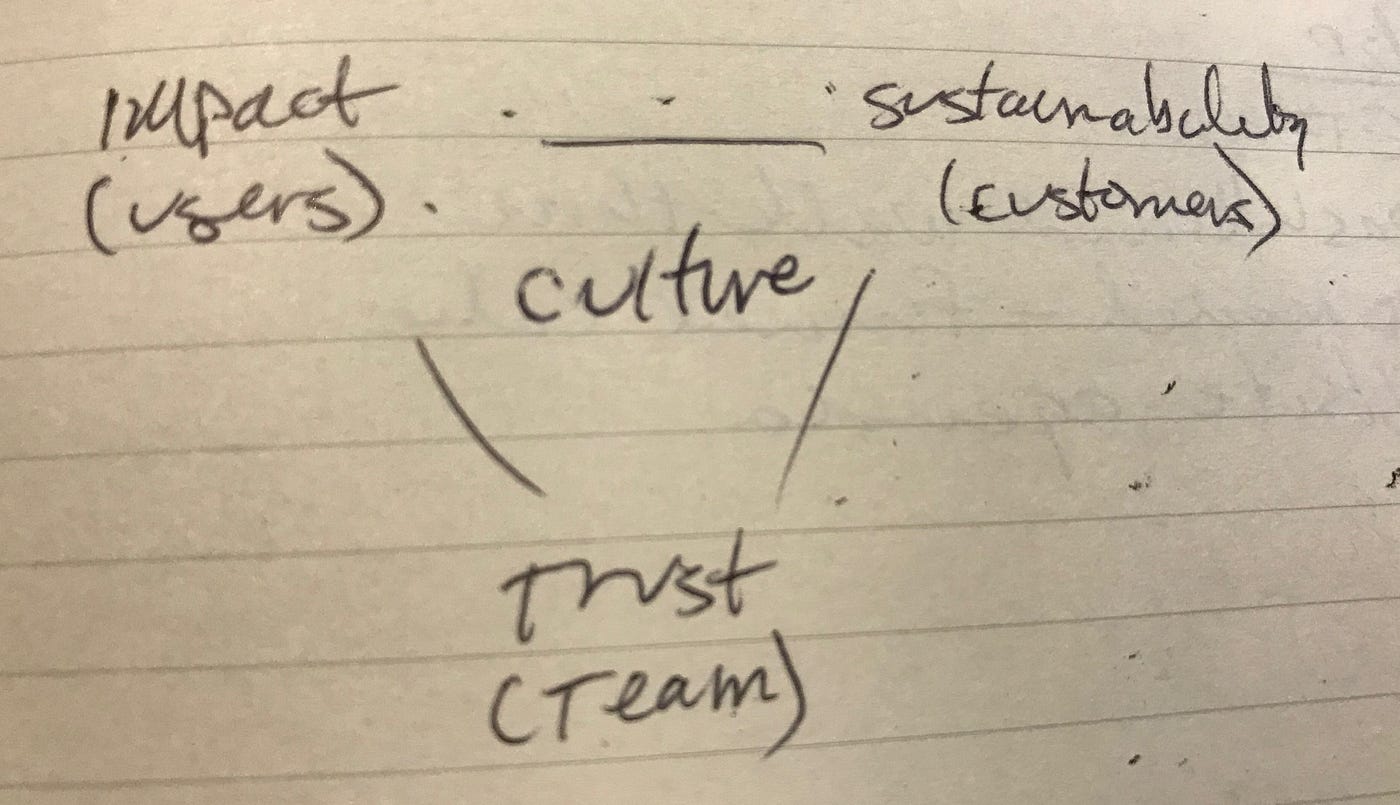
Show up for the impact your work delivers every day.
Here’s a simple rule: Don’t work for any company or on any project unless you feel an authentic connection to impact a specific set of users. For those of us at Remind we feel the clear connection between our work and the impact we have every day on the lives of millions of teachers, students, parents, and administrators. The communication platform we are building truly enables the development of important learning relationships between educators and families i.e. students and parents.
In my previous roles I often struggled to connect my daily efforts to meaningful impact. I kept asking myself “how impactful is the creation of sports media content and fantasy sports games to the well-being of the users of this content?” What I learned in those settings is that impact comes in many different shapes and sizes. My wife helped me understand that, for many sports fans around the world, what we created at Yahoo!, Fox Sports, and finally during my time at Bleacher Report, actually brought our users joy by connecting them to something they cared about deeply — their relationship with the sports and teams they loved. Ultimately we all do work that’s impactful to some set of users, we just need to decide if it’s the kind of impact that matters to us enough to show up. Working on machine learning, blockchain technologies (yes, including cryptocurrencies), driverless cars, food delivery services, or even enterprise software shouldn’t be judged any more or less impactful than working in education or healthcare. The key is to find a place where you employ your talents in a way that creates impact for users in a way that resonates with you.
Build a sustainable business that’s around long after you leave.
Once you’ve found a place where you see your work making a real impact, broaden your focus to ensure you create a company that can scale its impact indefinitely. This is what sustainability means for a startup. It means crafting a product or service that actually fits a market and that can one day grow into a profitable business. In turn, this means understanding the difference between users and customers. In some cases these two stakeholders may be the same group of people. For example, the food delivery service Thistle (to which I used to subscribe) delivers impact to me the “user” by providing healthy meals to me the “customer” a couple days a week in a way that is being done (hopefully) in an economically sustainable way.
In other settings, however, the users you impact and engage with your product or service may be different than the customers who essentially pay for the value that your product delivers. For example, at Remind our teacher, student, and parent users who actively engage around student learning on our platform are different from the school and district administrators who increasingly become customers paying us for the value Remind delivers to them. Likewise, the advertising-supported media business delivers content to users (i.e. the audience) who are separate from a media company’s customers (i.e. the advertisers). Once you’ve found where you want to make an impact, be sure to in parallel turn your attention to the ways you engage with customers so that you build a sustainable (read: profitable) business that delivers impact forever.
Invest most of your time at work building relationships based on trust.
Once the company has brought together people motivated to create impact for users, and these same individuals clearly understand — and are committed to — the importance of delivering impact in a sustainable way, the final step is to work hard every day to support this mutual desire for impact and sustainability on a foundation of trust. Just like impact ties to users and sustainability connects to customers, trust stems from teams. As companies grow, the “company team” becomes composed of many smaller, functionally focused teams. The working relationships between these sub-teams must be aligned to the company’s vision, mission, and values, and these relationships must also align with how the company positively impacts users while simultaneously developing a sustainable business by establishing customer relationships. Most importantly though, the success of the full “company team” becomes predicated on the trust that develops within — and across — these sub-teams.
Many examples exist for what trust look likes at the sub-team level. A short, yet by no means exhaustive, list of what some of these important sub-team trust-based relationships look like include:
Product Management and Engineering trusting that they can work together to ship the best product possible — on-time and at the highest quality bar achievable — for users and customers.
Sales and Product Management trusting that their collaboration to deliver the best product possible strikes the perfect balance between delivering user engagement and exceptional customer value.
Marketing and Customer Success trusting that the interactions they share with customers can lead to great case studies that showcase the value being created for customers, and that can ultimately lead to exceeding customer renewal rates.
Engineering and Finance trusting that the company’s technology infrastructure decisions are being made to support long-term scale while optimizing for operating margin goals that demonstrate the sustainable value being created by the company.
Marketing, Sales, and Finance trusting that they collectively will bring their unique expertise together to define how the company most efficiently acquires users and customers, and then turns this acquisition effort into a large, healthily growing, and profitable customer base that supports the long-term impact the entire team aims to achieve.
Management guru Peter Drucker famously stated “culture eats strategy for breakfast.” I couldn’t agree more. There is something quite simple — yet equally powerful — when a company brings together a unified focus to create impact for users, to deliver sustainability through customer value, and to forge an amazing teamwork-based ethos built on trust. By striving in parallel for impact and sustainability, while doing so on top a foundation of trust, feels to me one of the best ways to align an enduring company culture. Indeed, a company culture that not only endures, but endures amidst rapidly evolving business environments that render a company’s strategy viable only as everyone maintains a focus on truly realizing impact, sustainability, and trust.
Originally published on Medium on March 16, 2018. This Substack version is maintained as the canonical archive.